
RANGER Dog Doors for Doors
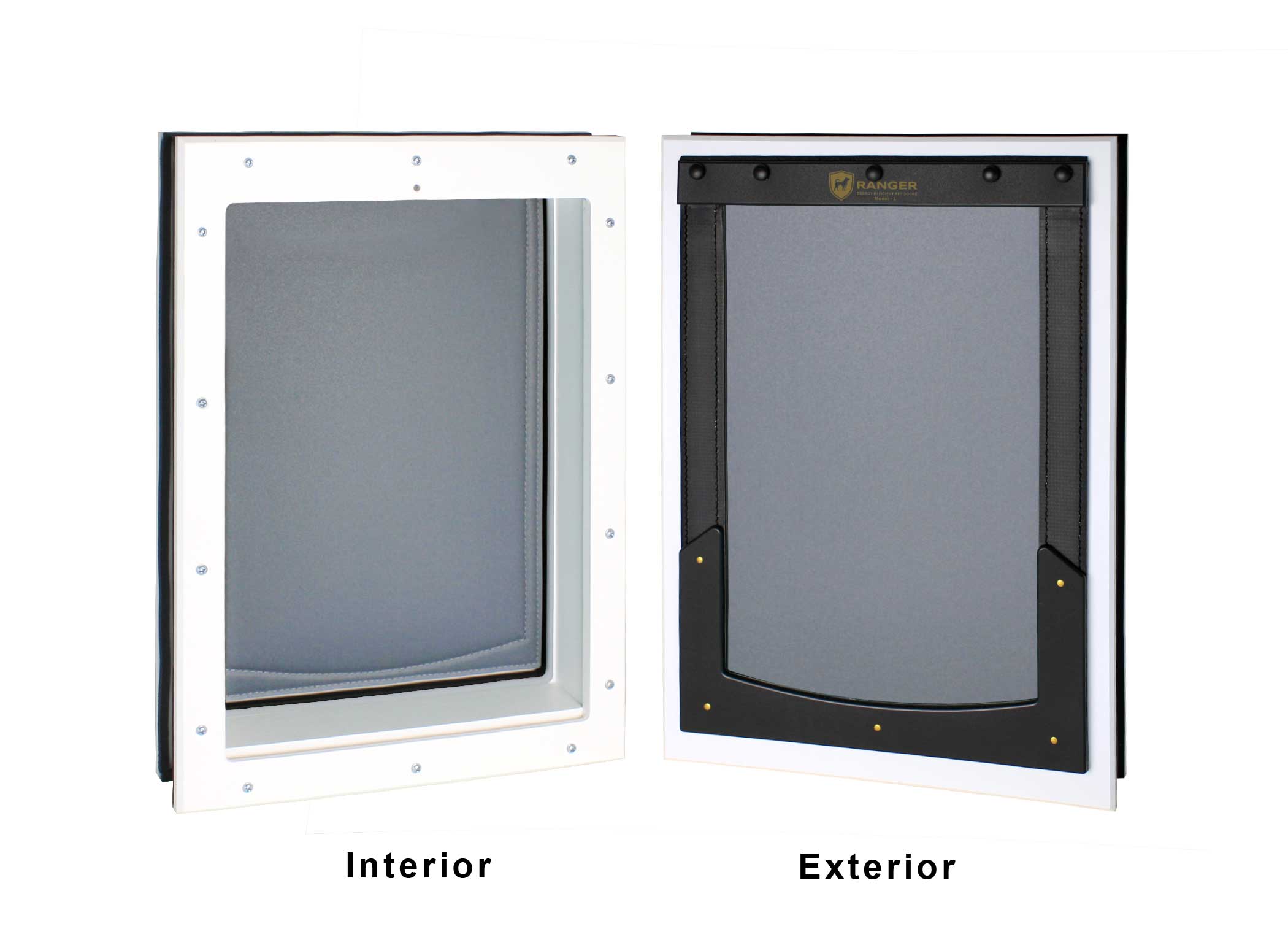


RANGER Dog Doors for Doors
Insulated Flap Seals Out Extreme Temperatures
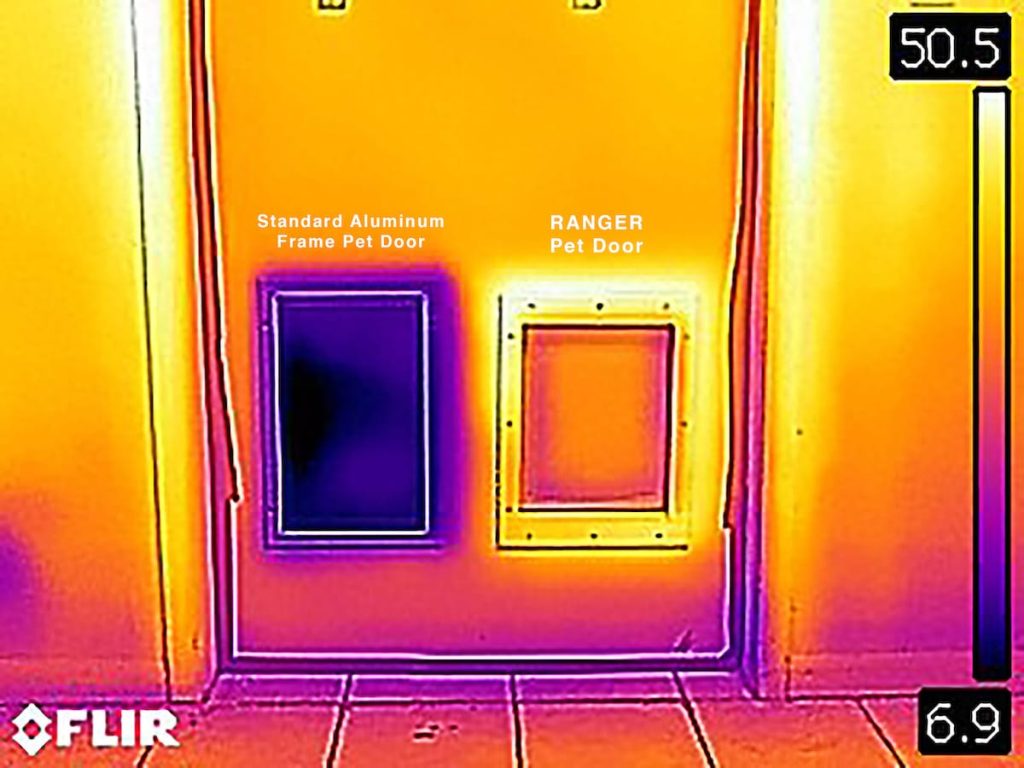
Right: RANGER, registering at room temp
Outside temperature was -1° F (-18° C) and indoor temperature was 55° F (13° C). Oranges, yellows, and whites are areas of relatively warm temperature, while purples and blacks are areas of relatively cold temperatures. Temperature scale is on the right of the image.
Avoid Leaky Pet Doors
Most doggie doors are extremely leaky.
In fact, over 90% of the energy loss from conventional pet doors comes from air leakage – letting cold air directly into your home.
The RANGER dog door with DoubleMag seal is virtually airtight, so it keeps outdoor air outside where it belongs.
15X Better than Energy Star
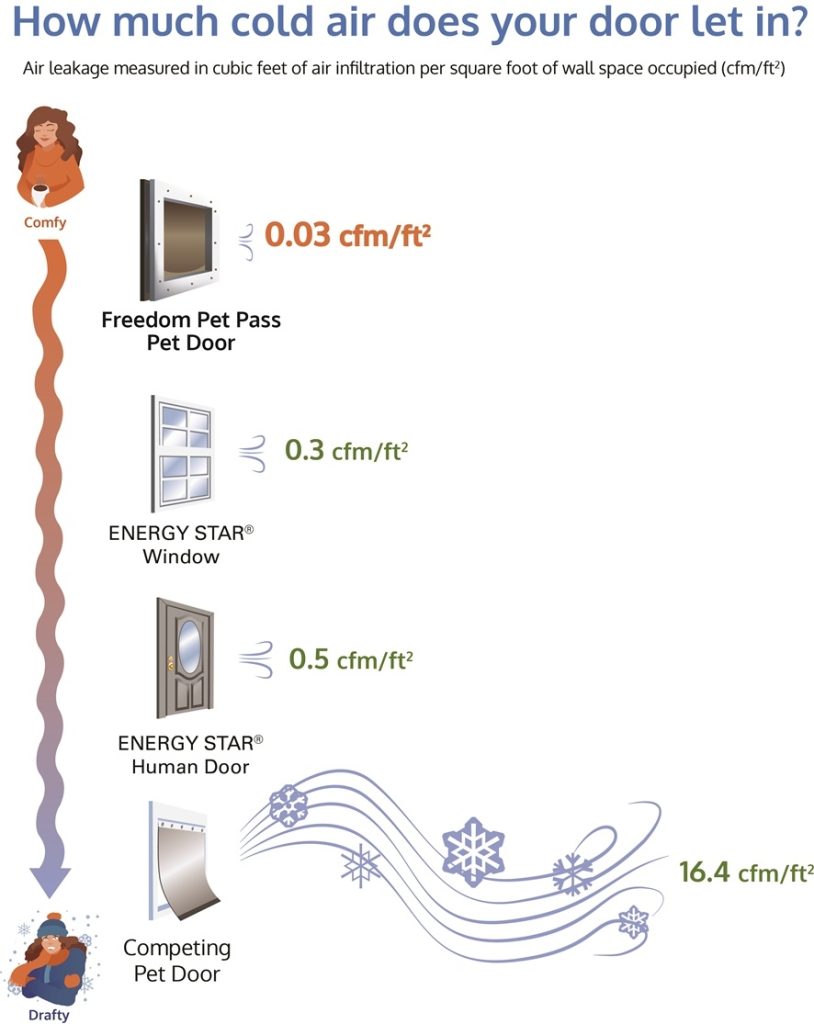
The DoubleMag seal is so good, third-party lab testing showed that it is 15X better at preventing outside air from coming in than US Energy Star requirements for human doors.
500X Better than Other Pet Doors
Other brands pet doors don’t actually make a seal. Even those with a “double flap” or magnets to “keep the door closed” aren’t good enough, because they don’t actually seal out the wind and drafts.
Lab testing with the “best selling” pet door shows how much better RANGER dog doors by Freedom Pet Pass perform. Under official testing conditions, the competitive door leaks over 16 cubic feet of air per minute per square foot.
That’s over 500X worse than the RANGER dog door standard of 0.03 cfm/sq ft!
15X Better than Energy Star Standards
Insulated Flap System
RANGER dog doors by Freedom Pet Pass have a thick, insulated flap to reduce conductive heat loss, which is heat loss through material. Made for cold weather, the flap components will stay flexible and functional to -40 and below.
Insulated Frame Material
The cellular PVC used in our frame is 3,000X more insulating than the aluminum material used in the frames of lesser doggie doors.
Zero Drafts
With pet doors, most energy loss comes from convective heat loss – cold air blowing in around a poor seal. The DoubleMag seal on RANGER Pet Doors eliminates air leaks.
Actual Lab Data – Not Marketing Hype

Many dog doors “claim” energy-efficiency with bogus comparisons and no proof.
RANGER dog doors have extensive independent laboratory testing that prove how efficient they are.
Our doors are evaluated using the same tests that are used for Energy Star certification for windows and human doors, and the results show that RANGER dog doors are 15X better at blocking outside air than requirements for human doors.
Engineered from the Best Raw Materials

Note: to prevent injury to pets and damage to the door, do not use the security panel to lock your pets outside.
Cellular PVC Frame
Strong, weatherproof, and mold-resistant, and 3,000X more insulating than metal frames used on lower-end dog doors.
Rugged Flap System
The insulated flap system is made from premium materials for maximum energy-efficiency, pet safety, and durability. The flap has an insulating SBR rubber core, protected with marine-grade canvas on each side. The flap seal is made from thermoplastic polyolefin, a material also used for industrial roofing.
Locking Security Panel
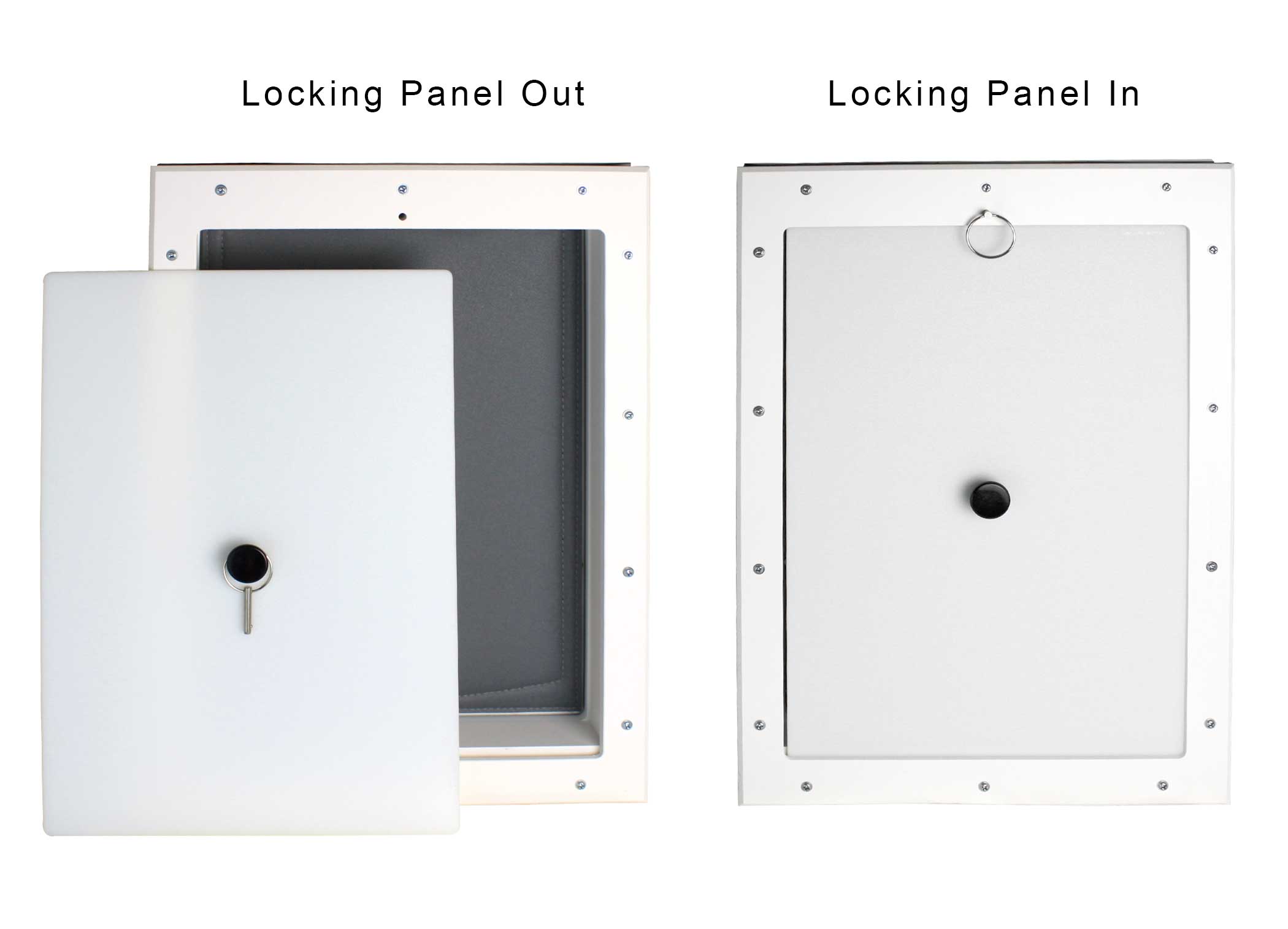
All door-mounted RANGER dog doors include a locking security panel. The “up-and-in” insertion of the panel means no additional clearance is needed around the pet door.
Pet Door Sizing
| Size | Pet Opening | Example Breed |
|---|---|---|
 | 6” x 10” (155 x 255 mm) | Shin Tzu, Cats |
 | 9” x 13” (230 x 330 mm) | Beagles |
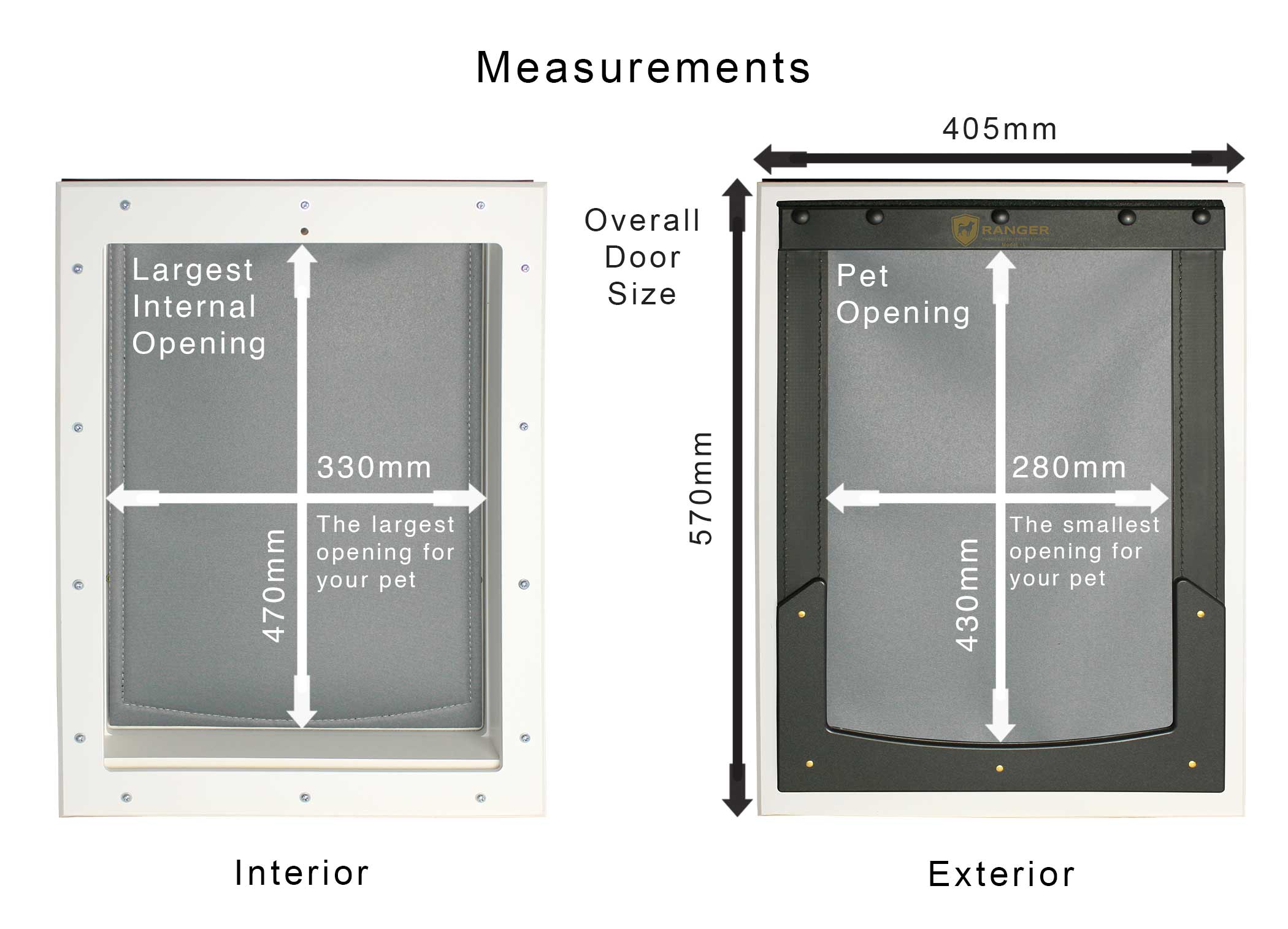
 | 11” x 17” (280 x 430 mm) | Lab Retrievers |
 | 16” x 23” (405 x 580 mm) | Great Danes |
Pet Door Dimensions

| Size | Pet Opening | Rough Opening | Frame Size |
|---|---|---|---|
| XL | 16” x 23” 405 x 580mm | 20 3/4” x 29” 530 x 740mm | 21 3/4” x 30” 550 x 760mm |
| Lg | 11” x 17” 280 x 430mm | 15” x 21 1/2” 380 x 545mm | 16” x 22 1/2” 405 x 570mm |
| Med | 9” x 13” 230 x 330mm | 13” x 17 1/2” 330 x 445mm | 14” x 18 1/2” 355 x 470mm |
| Sm | 6” x 10” 155 x 255mm | 10” x 14 1/2” 255 x 370mm | 10” x 14 1/2” 280 x 395mm |
| Size | Pet Opening | Rough Opening | Frame Size |
|---|---|---|---|
| XL | 16” x 23” 405 x 580mm | 20 3/4” x 29” 530 x 740mm | 21 3/4” x 30” 550 x 760mm |
| Lg | 11” x 17” 280 x 430mm | 15” x 21 1/2” 380 x 545mm | 16” x 22 1/2” 405 x 570mm |
| Med | 9” x 13” 230 x 330mm | 13” x 17 1/2” 330 x 445mm | 14” x 18 1/2” 355 x 470mm |
| Sm | 6” x 10” 155 x 255mm | 10” x 14 1/2” 255 x 370mm | 10” x 14 1/2” 280 x 395mm |
Cardboard Cutout Test

- This sizing method requires a big piece of corrugated cardboard. Start with the pet opening size you think is most appropriate for the pet in mind.
- Cutout either the 6”x10” (small), 9”x13” (medium), 11”x17” (large), or 16” x 23” (XL) pet opening rectangle out of the cardboard up high and fold it at the bottom so that when the piece of cardboard is placed in a doorway, the top of the hole of the rectangle is approximately one inch to an inch and a half higher than your pet, at the withers or shoulders.
- Step on the folded end of the cardboard, and invite your pet through the opening. Watch for clearance high and low.
- If the size of the cutout you try is inappropriate, change to the next size up or down as required. Remember, it is always better to err on the side of being too large.
Written Instructions

RANGER door-mounted pet doors come with thorough written installation instructions. If you would like to download and print the written instructions, click the button below or the picture of the instructions.
If, after reviewing these instructions, you are not confident in your abilities to successfully install the pet door, you should consider enlisting the help of a licensed contractor or handyman.
Prework: Tools

Tools required to install a RANGER by Freedom Pet Pass door-mounted pet door into a raised panel door include the following:
- Safety glasses
- Ear protection
- Tape measure
- Clamps
- Battery operated drill
- Shield
- Skill saw
- Proper blade
- File
- Caulk gun
- Blue painters tape
- Squares
- Level or straight edge
1. Measure Your Pet

Measure your tallest pet to the withers (front shoulders).
Make a mark on the interior side of your human door at least 3” (5 cm) higher than your tallest pet’s height at the withers. This ensures that your tallest dog will be able to pass through the pet door without putting stress on his or her knees and back. If you can spare it, consider giving a little extra cushion on the height.
Alternatively, if you have done the cardboard cutout test (described in the Sizing section), you can use the cardboard cutout for this step. This is what is shown in the first part of the video in Step 2. Either method gives the same result.
Many people ask, “how far off of the floor should the door be?” This is typically not as important as making sure the top of the door is high enough. Most dogs pick up their legs quite a bit as part of their natural gait, so they can clear many inches without interrupting their stride. For households with tall and short pets, the door should be mounted for ergonomic use by the tallest pet. Shorter pets can be accommodated with something like our Pet Step.
2. Trace the Rough Cut Line
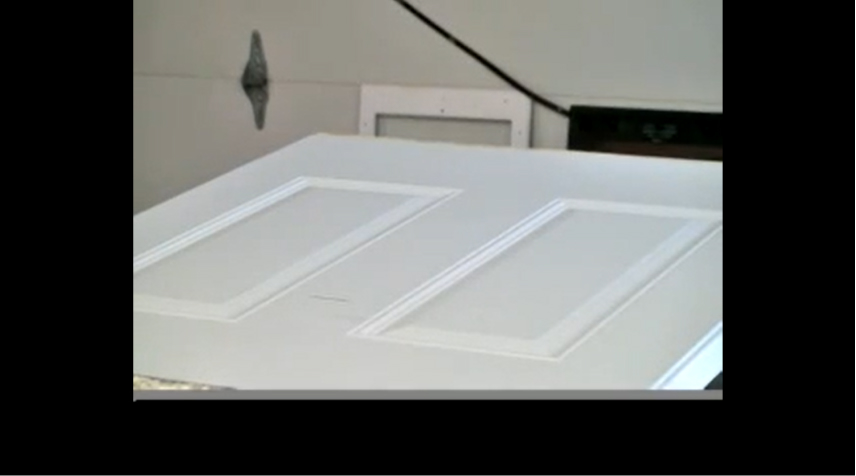
Begin the project with the interior of your home door facing up on saw horses. The object here is to locate and place the product where it will best fit your door and your dog. Pre-measure for the dog.
Take the pet door (the piece with the flap) and place the inside center of the frame on the line that you’ve drawn to determine the height that will best fit your door and your dog. Double check your side measurements to make sure your door is centered, and double check your height measurements. Once this has been completed, trace around the outside of the door with pencil.
3. Cut Hole in Door
Begin with a good saw and the proper blade installed to cut through your home door application. Use a metal blade for metal doors, a wood blade for wood doors, etc. If possible, use a new blade when cutting the opening. We don’t recommend cutting into your door if it is your first time using a saw.
Start your cut at the back corner and work counter clockwise around the door.
Line up the saw blade with the pencil line and with a good grip on the saw carefully begin your cut.
Once the cut is complete on the inside of the door, flip the door over on the sawhorses (to external side). Use clamps and a bar to secure the cutout in place. You don’t want it dropping through prior to completing the cut.
Use a square to trace in the corners that still need to be cut. Use the saw to make the final cuts in the corners.
Tap out the cut piece to reveal the rough opening. File the edges if needed.
4. Attach Pet Door
Place the pet door into the hole with the exterior side of the pet door (the side with the flap system) oriented to the exterior side of the door and the hinge of the flap oriented toward the top. Clamp the pet door in place, and flip the door over.
Place the interior frame on the door. Align the interior frame to the rest of the pet door using the locking pin on the top and the bottom middle screw to ensure that the two pieces are mated squarely.
Put the other screws into the other holes, and then carefully tighten. Be careful if using an electric or battery-operated screwdriver, as over tightening can damage the frame. If you’re using a screw gun, consider driving the screws mostly in and tightening the screws with a hand screwdriver.
Technical Data Sheet

The technical data sheet (TDS) provides a summary of all of the technical details of RANGER Pet Doors.
The TDS includes all dimensional information as well as energy-efficiency testing for all pet doors.
ASTM E-283 Air Leakage
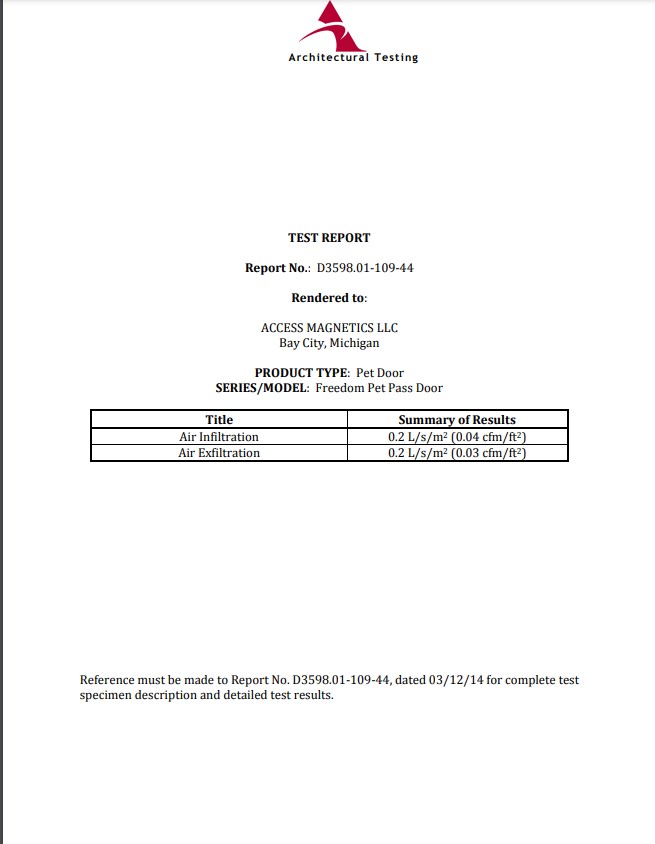
ASTM E-283 the official testing protocol for air leakage for fenestration products (human doors, windows, skylights, pet doors, etc.).
Testing at Architectural Testing, Inc. gave official air leakage of 0.03 cfm/ft2. Converted to metric, that is 0.15 L/s/m2, rounded by rule in the report to 0.2 L/s/m2.
These results are 15X better than US Energy Star requirements for human doors, and 10X Canada’s requirements.
This measurement is important because for most pet doors, air leakage (drafts) are the overwhelming source of energy loss.
ASTM C-1199 U-Factor

ASTM C-1199 is a testing protocol to determine the U-factor (insulation factor) of fenestration materials like doors, windows, skylights, and pet doors.
U-factor measures how much / how quickly heat flows through through a material, so with this measurement, the smaller the number is, the better the performance.
Our pet doors were tested and found to have a U-factor of 0.22 Btu/(hr∙ft2∙F). This equates to a metric value of 1.2 W/(m2∙K).
California Title 24

The State of California was the first jurisdiction to specify energy performance requirements for pet doors
Issue 104 of the California Energy Commission’s Blueprint newsletter specifies how pet doors are to be evaluated for compliance with Title 24 Energy-Efficiency Requirements.
On page 4 of this issue, the Commission states that pet doors are considered doors, and they are required to have an independently-determined U-factor and an air leakage rate of less than 0.3 cfm/ft2. The RANGER pet door is 10X better than this standard.
Frequently Asked Questions
30-ish Day Return Policy
If you are not 100% satisfied with your purchase, you may return the item for a refund.
We’re not sticklers for timeline, but please try to make your decision within a month or so of delivery.
Warranty
RANGER Pet Doors come with a 3-year limited warranty against malfunction due to manufacturing or material defects.
Lifetime Support
RANGER Pet Doors are designed to be the last pet door you ever have to buy.
We will always support owners of our pet doors, regardless of when they were bought or from whom. We will always maintain stocks of replacement parts, even for our oldest doors.
If you ever have any questions about your pet door, even if it’s really old or you’re not the original owner, please don’t hesitate to reach out and contact us.
djlove –
We, like probably many, were a little hesitant to spend the money for this pet door, but after seeing so many of the pet doors my friend’s had and how they did not seal well, we decided to spend the extra money and buy one that looked to be much better quality and are we glad we did! We live in Northeast Oregon where it can and does snow as early as August and as late as June. The winters are COLD here with often a strong wind/chill factor and getting down into the negative numbers too much for my taste. This door is AMAZING. We have a German Shepherd who goes in and out of it so many times a day, I can’t count and after more than a year of this constant activity, other than her dirty nose marks on the flap (I should have gotten a different color) it looks and performs like brand new. Have I mentioned that it is amazing? Yes, it costs more, but we probably would have replaced a cheaper one at least once already and ended up with snow inside. Not to mention the freezing cold. Thanks for making such an excellent product!
Donald Love –
I left a detailed review under CT on August 13, 2021. This is an update. I LOVE this pet door!! Don’t look at any other brand! Adding to my positives which you can read: The number of bugs in my house has dropped to near zero. I used to have spiders all over, especially in the sun-room where the pet door is I could have vaccummed up spider-webs every day (also had constant flies, lady bugs, centipedes and crickets in that room seasonally). They are gone! The door is secure and blocks everything out. I was concerned about having to get a large to accommodate my two dogs different size and that is not a problem. The door is tight and functional.